ELECTRICAL SAFETY
ELECTRICITY is an integral part of today’s modern world but it can also shock you painfully, damage sensitive equipment and ignite combustible materials. Electrical accidents are taking place in spite of advancement in technology which underlines the need for timely safety. Electrocutions rank 4th in causes of human death after traffic, violence and construction. 42 % of total fires occurring due to electrical sources.
ELECTRIC SHOCK occurs when the human body becomes part of the path through which current flows. The direct result can be electrocution. The indirect result can be injury, Organ failure, burning of skin, fatal accident due to fall or movement.
Many electrocutions and Electrical accidents can be prevented simply by understanding basic electrical safety principles and adhering to safe practices.
POWER QUALITY
The electrical network's ability to supply a clean and stable power. Good power quality ideally creates a perfect power supply that is always available, has a pure noise-free, sinusoidal wave shape, and is always within voltage and frequency tolerances. A number of power quality issues including electrical harmonics, poor power factor, voltage instability and Load imbalance impact on the performance of electrical equipment. This has a number of consequences including: Higher energy usage and costs, Higher maintenance costs and Equipment instability and failure.
ENERGY EFFICIENCY
Rapidly increasing energy prices, concerns about resource depletion and climate change creating pressure on governments to emphasize on energy efficiency. The potential for energy savings in new buildings is 40-50% if energy efficiency measures are included in the design stage. For existing buildings, the potential energy savings could be as high as 20-25% after retrofits. There exist tremendous opportunities to introduce new materials, equipment and technologies which can help enhance energy efficiency of buildings. An energy efficient building is one which has energy conscious design, replaces traditional sources of energy by renewable energy resources, and is provided with energy saving appliances, allows for the conservation of energy and water.
RENEWABLE ENERGY (ROOF TOP SOLAR PV)
Power is the lifeline for development of any nation. Until 1st decade of this century, the power requirement in India is being met by thermal (70%), Hydel (21%) and Nuclear (4%). Hydel and Nuclear have their inherent limitations. Thermal Power is often confronted by the challenges associated with the availability of fuel, requirement of huge funds and involves issues of growing environmental concern. In order to bring down the dependence of finite fossil fuel for power generation, it is necessary to look into the viability of generating power locally using renewable energy sources.
Fortunately, India lies in sunny regions of the world and most parts of India receive 5 – 7 kWh of solar radiation per square meter per day with 300-325 sunny days in a year.
Government of India has set up a Ministry called MNRE – Ministry of New and Renewable Energy for the promotion of Power Generation through Renewable Energy. The Ministry has been facilitating the implementation of broad spectrum program’s including harnessing renewable Energy. Apart from augmenting the energy supply, renewable resources will help India in mitigating climate change and protect FOREX reserves.
EV CHARGING
An electric vehicle (EV) is one that operates on an electric motor, instead of an internal-combustion engine and consumes battery Stored Energy rather than gas or liquid fuel. In order to address the issue of rising pollution, global warming, depleting natural resources, etc. the concept of electric vehicles has drawn a considerable amount of interest.
The standard for modern battery electric vehicles is lithium ion (MNC) batteries as they have a greater longevity and are excellent at retaining energy, with a self-discharge rate of just 5% per month. Major advantages for Electric Vehicles over Internal Combustion Engines are
- Creates very little noise.
- No exhaust, spark plugs, clutch or gears.
- Doesn’t burn fossil fuels, instead uses rechargeable batteries.
Adaptation of Electric Vehicles in India crated lot of opportunity for design and Development of EV Charging Infrastructure. This is going to be the revolution and game changer in the field of surface transportation leaving tremendous potential for infrastructure development in the tune of few thousand mega Watts in coming years.
Smart Grid Technology
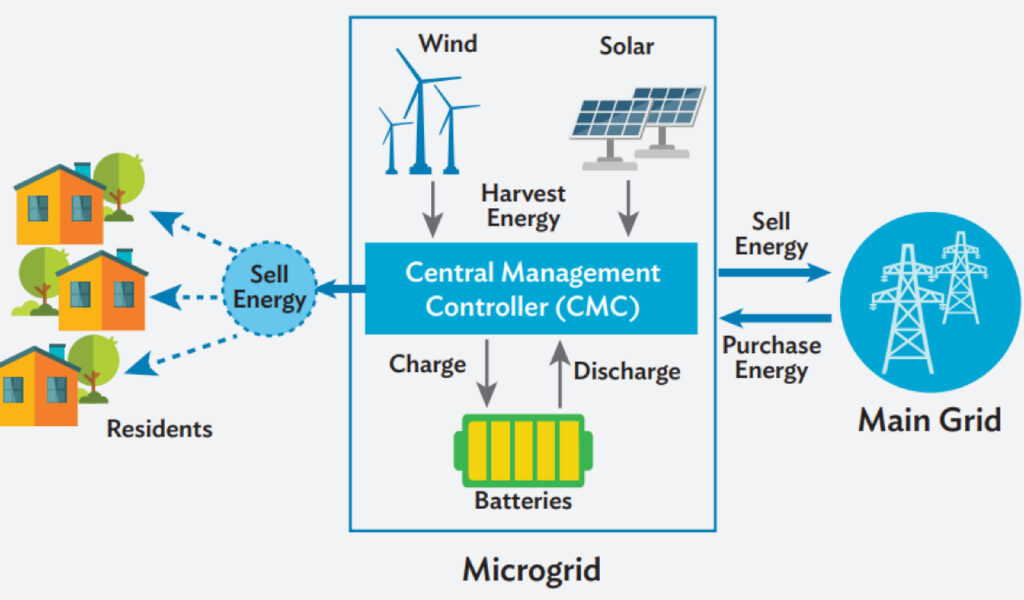
A micro grid is a localized group of interconnected loads and distributed energy resources (DERs) within clearly defined electrical boundaries (e.g., cities, communities, campuses that act as a single controllable entity with respect to the main regional or national electric grid [macro grid]). A micro grid can connect or disconnect from the main grid based on technical and economic conditions. It can operate on both grid-connected mode or on island mode. Micro grid technology represents a transformative force in the pursuit of grid modernization, electrification of everything, directionality, and energy efficiency. By embracing the latest trends in micro grid technology, we can create a more sustainable and resilient energy infrastructure